
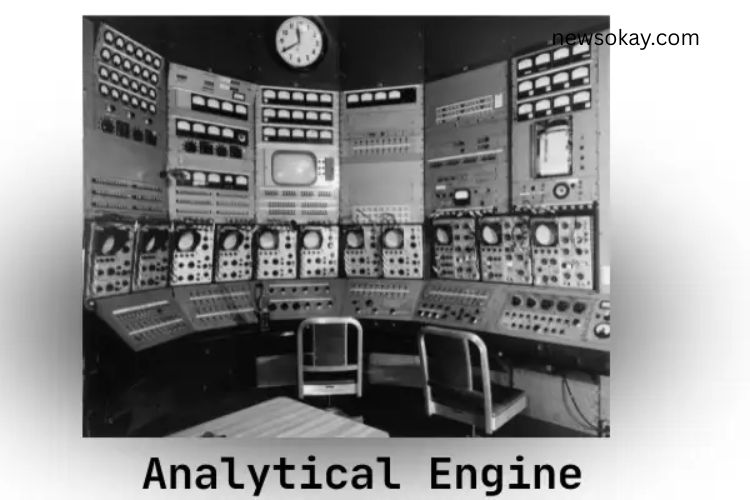
The Analytical Engine, invented by Charles Babbage in 1837, is widely regarded as the first concept of a programmable computer. Designed to perform complex calculations automatically, this groundbreaking machine used punched cards to store data and execute instructions. Although Babbage never completed the engine, its design laid the foundation for the computers we use today. The Analytical Engine marked a revolutionary step in computational thinking and demonstrated the potential for machines to process information independently.
Read More: https://newsokay.com/computer-security-protect-defend-and-empower/
The History of the Analytical Engine
Charles Babbage designed the Analytical Engine to solve problems autonomously, a concept far ahead of its time. Unlike earlier calculating devices, the engine was meant to execute a sequence of operations without human intervention. This invention transformed the understanding of machinery and computation. Babbage’s work inspired generations of engineers and mathematicians, eventually shaping modern computing systems. The Analytical Engine’s legacy lies in its vision: a machine capable of universal computation.
The Concept Behind the Engine
Babbage’s idea emerged from his desire to automate mathematical calculations. In 1837, he envisioned a machine that could compute numbers faster and more accurately than humans. He recognized that manual calculation was time-consuming and prone to error, so he set out to design a mechanical system capable of executing programmed operations. This concept of automated problem-solving was revolutionary and remains the core principle behind today’s computers.
Design and Key Features
The Analytical Engine featured several innovative components, each essential for its operation:
The Mill: This unit performed arithmetic operations such as addition, subtraction, multiplication, and division, functioning like a modern CPU.
- The Store: Acting as memory, it stored numbers and intermediate results for use during calculations.
- Input Mechanism: Punched cards provided data and instructions, similar to how early Jacquard looms used cards to control weaving patterns.
- Control Unit: This component ensured operations occurred in the correct sequence, interpreting instructions and managing workflow.
- Output Unit: Results were displayed, printed, or recorded on punched cards for later use.
The engine’s design allowed programmable operations, conditional logic, and sequential instruction execution, reflecting features found in modern computing systems.
Ada Lovelace and the First Algorithm
Ada Lovelace, a brilliant mathematician, collaborated with Babbage to develop the Analytical Engine’s potential. She created the first algorithm designed for the machine, effectively becoming the world’s first computer programmer. Lovelace also foresaw that such machines could extend beyond number-crunching to handle more abstract tasks, including symbolic computation. Her insights emphasized the broader applications of computing, predicting modern software development principles over a century in advance.
Challenges Faced by Babbage
Despite its brilliance, the Analytical Engine was never completed. Several obstacles hindered its construction:
- Complex Design: The machine’s mechanical intricacy exceeded the technological capabilities of the 19th century.
- High Costs: Securing funds for such an ambitious project proved difficult.
- Mechanical Limitations: Components were prone to wear and errors, limiting reliability.
- Size and Weight: The machine would have been massive, challenging to assemble and operate.
- Skilled Workforce Shortage: Few engineers had the expertise to construct and maintain such a sophisticated device.
- Criticism and Opposition: Many contemporaries doubted its usefulness, dismissing Babbage’s vision.
These issues prevented the realization of a fully operational engine, but its theoretical framework remained profoundly influential.
Functional Units of the Analytical Engine
The Analytical Engine comprised several interdependent units that executed tasks systematically:
Input Unit
Data and instructions were fed into the engine using punched cards. Each card represented specific operations, allowing the machine to interpret and follow programmed sequences.
Arithmetic Unit (Mill)
The Mill performed calculations, including addition, subtraction, multiplication, and division. Acting as the engine’s computational core, it processed data according to instructions from the punched cards.
Memory Unit (Store)
The Store functioned as temporary storage, holding numbers and intermediate results. This concept is analogous to modern computer RAM, providing rapid access to critical information during computation.
Output Unit
Once calculations were complete, the output unit displayed or printed results, ensuring users could interpret and utilize the engine’s findings.
Control Unit
The control unit coordinated all operations, directing data flow between the Mill, Store, and input/output mechanisms. It ensured sequential processing and accurate execution of instructions.
Features That Shaped Modern Computers
The Analytical Engine introduced several concepts that directly influenced modern computing:
- General-purpose Computation: Capable of performing a wide range of calculations, it was the first machine designed for universal computation.
- Programmability: Instructions could be modified using punched cards, allowing reprogramming for various tasks.
- Sequential Control and Conditional Logic: The engine could process instructions step-by-step and make decisions based on previous calculations.
- Decimal System Operations: Unlike modern binary computers, it performed calculations in base-10.
- Mechanical Power: Driven by steam, it relied entirely on mechanical components rather than electronics.
These features collectively demonstrated that machines could perform systematic, programmable problem-solving, laying the groundwork for modern CPUs, memory systems, and software logic.
Limitations of the Analytical Engine
Despite its revolutionary design, the Analytical Engine had significant limitations:
- Incomplete Construction: The engine was never fully built due to technical and financial constraints.
- Slow Mechanical Operation: Mechanical calculations were slower than electronic computation.
- Dependence on Steam Power: This limited efficiency and reliability.
- Practicality Issues: Its large size, weight, and mechanical complexity made real-world application difficult.
While these limitations prevented full implementation, the concepts introduced by Babbage were crucial in shaping computing theory and engineering practices.
The Legacy of the Analytical Engine
The Analytical Engine’s significance lies not in its physical construction but in its visionary design. It introduced the world to programmable machines, demonstrating that complex operations could be automated. The principles of modular computation, memory storage, sequential instruction, and conditional logic remain central to modern computing. Ada Lovelace’s algorithms highlighted the broader applications of programming beyond arithmetic, foreshadowing software development and artificial intelligence.
Modern computers, from personal devices to supercomputers, owe their conceptual foundations to the Analytical Engine. Babbage’s design inspired generations of inventors, mathematicians, and engineers, making it a cornerstone of computer history. Even today, studying the engine provides insight into the evolution of technology and computational thought.
Frequently Asked Questions:
What is the Analytical Engine?
The Analytical Engine is a mechanical computer designed by Charles Babbage in 1837. It was the first concept of a programmable machine capable of performing complex calculations automatically.
Who invented the Analytical Engine?
Charles Babbage, a British mathematician and engineer, invented the Analytical Engine. Ada Lovelace later collaborated with him, creating the first algorithm for the machine.
Why is the Analytical Engine important?
The Analytical Engine introduced the idea of a programmable computer, laying the foundation for modern computing. It demonstrated that machines could perform calculations without human intervention.
Was the Analytical Engine ever built?
No, the engine was never fully completed due to technological limitations, high costs, and mechanical complexity. However, its design inspired future computer inventions.
What were the main components of the Analytical Engine?
The engine had five main units: Input Unit (punched cards), Arithmetic Unit (Mill), Memory Unit (Store), Output Unit, and Control Unit. These components worked together to process data.
What role did Ada Lovelace play?
Ada Lovelace wrote the first algorithm for the Analytical Engine and predicted its broader potential beyond calculations, making her the world’s first computer programmer.
What were the limitations of the Analytical Engine?
It faced incomplete construction, mechanical limitations, slow operations, reliance on steam power, high costs, and a shortage of skilled workers.
Conclusion
The Analytical Engine stands as a symbol of vision, innovation, and the limitless potential of human ingenuity. Conceived by Charles Babbage and brought to life conceptually with Ada Lovelace’s pioneering algorithms, it introduced ideas that shaped the foundation of modern computing. While the machine was never fully built, its principles of programmability, memory storage, sequential processing, and automated calculation paved the way for today’s digital world. Understanding the Analytical Engine not only highlights the brilliance of its inventors but also inspires us to appreciate how far technology has come—and how one revolutionary idea can change the course of history.