

- How Does a Mechanical Keyboard Work?
- Types of Mechanical Keyboards
- Hot-Swappable Mechanical Keyboards
- Mechanical Keyboard Switch Colors and Their Feel
- Advantages of Mechanical Keyboards
- Drawbacks of Mechanical Keyboards
- Why Choose a Mechanical Keyboard?
- Tips for Beginners
- Frequently Asked Questions:
- What is a mechanical keyboard?
- Why should beginners choose a mechanical keyboard?
- How do mechanical keyboards work?
- Are mechanical keyboards noisy?
- Can I customize a mechanical keyboard?
- Are mechanical keyboards good for gaming?
- How do I maintain a mechanical keyboard?
- Are mechanical keyboards worth the investment?
- Conclusion
Mechanical keyboards have grown in popularity among gamers, typists, and professionals alike. Unlike standard keyboards, they feature individual switches under each key, providing fast, precise feedback with every press. These keyboards are not only durable but also offer a satisfying typing experience that many users prefer for both work and play.
A mechanical keyboard can produce soft or clicky sounds depending on the switch type. Their robust design ensures longevity, making them a favorite for anyone who types frequently or demands high performance from their keyboard.
Read More: https://newsokay.com/unlock-confidence-online/
How Does a Mechanical Keyboard Work?
Mechanical keyboards operate using specialized switches beneath every key. These switches create a responsive and reliable typing experience. Here’s how the process works:
- Press a Key: Your finger pushes a key down.
- Switch Moves: A small mechanical switch under the key moves in response.
- Contact is Made: The switch touches a metal part or circuit inside the keyboard.
- Signal is Sent: This contact generates an electrical signal.
- Computer Receives Signal: The keyboard sends the signal to your computer.
- Character Appears: The letter or action appears instantly on your screen.
This system ensures every keystroke is accurate and fast, which is why mechanical keyboards are preferred for gaming and typing-intensive tasks.
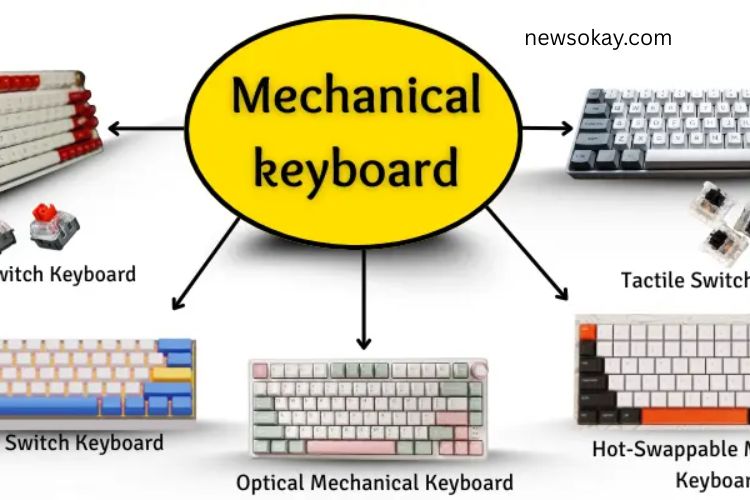
Types of Mechanical Keyboards
Mechanical keyboards come in various types, each providing a distinct feel and sound. Choosing the right one depends on your typing habits and preferences.
Linear Switch Keyboards
Linear switches move smoothly without any tactile bump or noise. They are ideal for gamers who need rapid, uninterrupted keystrokes.
Tactile Switch Keyboards
Tactile switches provide a noticeable bump when pressed, offering physical feedback to confirm the key has registered. These are great for typists who rely on touch precision.
Clicky Switch Keyboards
Clicky switches produce a loud, satisfying click with every press. Many users enjoy the auditory feedback for typing satisfaction.
Hot-Swappable Mechanical Keyboards
Hot-swappable keyboards allow users to replace switches without tools. This makes it easy to experiment with different switch types.
Optical Mechanical Keyboards
Optical switches use light instead of metal to register keystrokes. They offer lightning-fast response times and longer durability.
Mechanical Keyboard Layouts
Mechanical keyboards come in different sizes and layouts, each designed for various use cases.
- Full-Size (100%): Includes all keys, including a number pad and arrow keys.
- Tenkeyless (TKL): Omits the number pad, saving desk space.
- 75% Layout: Keeps most keys compactly arranged.
- 65% Layout: Removes function keys and number pad but retains arrow keys.
- 60% Layout: Includes only the main typing keys, ideal for minimalists.
- 40% Layout: Extremely compact, used by keyboard enthusiasts.
- Split Keyboard: Divides the keyboard into two halves to improve ergonomics.
- Ortholinear Layout: Arranges keys in straight columns for efficient typing.
Mechanical Keyboard Switch Colors and Their Feel
Each mechanical keyboard switch color provides a different typing experience. Here’s a quick guide:
- Red Switch: Smooth and quiet; requires light pressure. Perfect for gaming.
- Blue Switch: Clicky and tactile; ideal for typists who enjoy audible feedback.
- Brown Switch: Tactile but quieter; balanced for both typing and gaming.
- Black Switch: Heavy and firm; preferred by fast typists needing precise control.
- Green Switch: Strong tactile feedback with loud clicks; loved by enthusiasts.
- Yellow Switch: Smooth, quiet, and responsive; suitable for fast gaming.
- White Switch: Soft click with light resistance; comfortable for prolonged use.
Advantages of Mechanical Keyboards
Mechanical keyboards offer several benefits that make them stand out from standard membrane keyboards:
- Durable and Long-Lasting: Designed to withstand heavy usage.
- Comfortable Typing: Provides better ergonomics for extended sessions.
- Fast Response: Ideal for gamers and professionals requiring quick key registration.
- Auditory Feedback: Clicky keys give satisfying confirmation.
- Easy Maintenance: Switches and keycaps can be replaced individually.
- Heavy-Duty Performance: Works well under intensive use.
Drawbacks of Mechanical Keyboards
Despite their advantages, mechanical keyboards have some downsides:
- Higher Cost: They are generally more expensive than standard keyboards.
- Loud Noise: Clicky switches can be disruptive in quiet environments.
- Heavier and Bulkier: Not ideal for travel or small desks.
- Varied Typing Pressure: Some switches require more force, which may not suit everyone.
- Space Requirements: Larger layouts take up more desk space.
Why Choose a Mechanical Keyboard?
Mechanical keyboards combine speed, precision, and durability. They are ideal for gamers who need quick responses, typists who value feedback, and professionals seeking long-term reliability. With numerous switch types, layouts, and colors, users can select a keyboard tailored to their personal preferences.
Additionally, modern mechanical keyboards offer customization options such as hot-swappable switches, RGB lighting, and ergonomic designs, enhancing both functionality and style. Whether you want a quiet office keyboard or a clicky gaming setup, there’s a mechanical keyboard designed for you.
Tips for Beginners
- Test Switches First: Try different switch types to find what feels comfortable.
- Consider Layout: Choose a layout that fits your desk space and usage needs.
- Check Build Quality: Look for sturdy keyboards with durable keycaps and switches.
- Maintenance Matters: Clean the keyboard regularly to maintain performance.
- Customize if Needed: Explore hot-swappable options for switching out keys easily.
Frequently Asked Questions:
What is a mechanical keyboard?
A mechanical keyboard uses individual switches under each key, providing fast, precise feedback and a satisfying typing experience. Unlike membrane keyboards, mechanical keyboards are durable and respond quickly to every keystroke.
Why should beginners choose a mechanical keyboard?
Mechanical keyboards offer better typing accuracy, faster response times, and customizable layouts, making them perfect for beginners who want to improve typing speed and comfort.
How do mechanical keyboards work?
When a key is pressed, its switch completes a circuit, sending an electrical signal to the computer. This registers the keystroke instantly, making mechanical keyboards highly responsive.
Are mechanical keyboards noisy?
It depends on the switch type. Clicky switches produce loud feedback, while linear or some tactile switches are quiet. Beginners can choose based on their environment and preference.
Can I customize a mechanical keyboard?
Yes! Many mechanical keyboards allow switch replacement, keycap customization, and RGB lighting. Hot-swappable models let you try different switches without tools.
Are mechanical keyboards good for gaming?
Absolutely. Mechanical keyboards provide fast response times, precise control, and durability, making them ideal for both casual and competitive gaming.
How do I maintain a mechanical keyboard?
Regular cleaning of keycaps and switches, avoiding spills, and replacing worn switches will ensure longevity. Some keyboards allow easy removal of keycaps for cleaning.
Are mechanical keyboards worth the investment?
Yes. While they are more expensive than standard keyboards, their durability, typing comfort, and performance make them a worthwhile choice for beginners and professionals alike.
Conclusion
Mechanical keyboards are more than just typing tools—they are a gateway to speed, precision, and an enjoyable typing experience. With a variety of switch types, layouts, and customization options, they cater to gamers, typists, and professionals alike. Beginners can find a keyboard that fits their style, whether they prefer quiet, smooth keystrokes or satisfying, clicky feedback. Investing in a mechanical keyboard means choosing durability, comfort, and performance. By understanding the different switches, layouts, and features, anyone can unlock the full potential of typing mastery. Upgrade your setup today and experience the unmatched responsiveness, control, and satisfaction that only a mechanical keyboard can provide.