

- What is Middleware Software?
- History of Middleware Software
- How Middleware Software Works
- Types of Middleware Software
- Key Components of Middleware Software
- Middleware Software Categories
- Use Cases of Middleware Software
- Advantages and Disadvantages of Middleware Software
- Frequently Asked Questions:
- What makes middleware software “revolutionary”?
- How does middleware empower seamless integration?
- Can middleware improve system performance?
- What are the key components of middleware software?
- Which industries benefit the most from middleware?
- How does middleware enhance cloud and IoT solutions?
- Are there any challenges with middleware implementation?
- Conclusion
Middleware software is a powerful tool that enables different software systems to communicate and work together. Acting as a bridge between applications, middleware ensures smooth data exchange and coordinated functionality. Without it, programs might struggle to share information, causing inefficiencies and slow performance. Today, middleware plays a vital role in websites, mobile apps, enterprise systems, and cloud-based services, making modern digital ecosystems functional and scalable.
Read More: https://newsokay.com/genius-of-the-analytical-engine-a-simple/
What is Middleware Software?
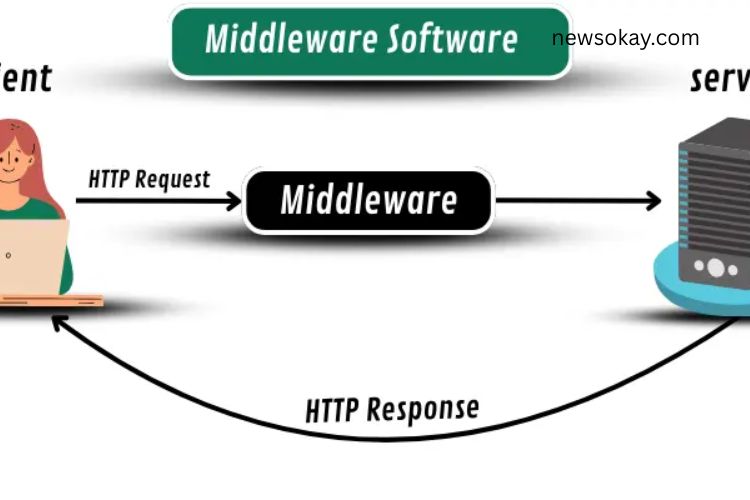
Middleware is a computer program designed to connect two or more software applications. Its primary purpose is to ensure that data flows seamlessly between systems, enabling them to operate in harmony. For businesses and developers, middleware simplifies complex integration tasks, improves system efficiency, and reduces errors caused by incompatible software.
Think of middleware as the “glue” that holds software ecosystems together. It allows applications to exchange data, execute commands, and collaborate without requiring developers to build custom connections for every system. This capability makes middleware indispensable in today’s interconnected technological landscape.
History of Middleware Software
Middleware software has a rich history dating back to the 1960s, when computers were large, isolated machines. At that time, connecting different systems was a challenge. By the 1980s, middleware emerged as a solution, providing a way for applications to communicate across computers.
Initially, middleware focused on basic data exchange, but over the decades, it evolved into sophisticated solutions capable of managing complex interactions across multiple platforms. Today, middleware is a cornerstone of enterprise IT infrastructure, cloud services, mobile applications, and Internet of Things (IoT) ecosystems.
How Middleware Software Works
Middleware acts as an intermediary between applications, ensuring that messages, requests, and data are transmitted efficiently. Its key functions include:
Connecting Applications: Middleware links programs, enabling them to communicate even if they use different programming languages.
- Data Transfer: It reliably transfers data between applications without loss or corruption.
- Compatibility Management: Middleware ensures that software components interpret data consistently.
- Request Handling: It manages communication requests, making processes faster and more reliable.
- Organizing Information Flow: Middleware structures how data moves between applications to prevent conflicts and bottlenecks.
By performing these tasks, middleware creates a stable environment where multiple applications can work together seamlessly.
Types of Middleware Software
Middleware comes in various types, each designed to meet specific integration needs. Some focus on messaging, others on database connections or web communication. The main types include:
- Message-Oriented Middleware (MOM): Enables applications to send and receive messages efficiently.
- Object Request Brokers (ORBs): Allows programs to communicate across different languages and platforms.
- Database Middleware: Connects software to databases for retrieving and storing information.
- Remote Procedure Call (RPC) Middleware: Lets one application request services from another, even on a remote server.
- Web Middleware: Facilitates interaction between websites, web applications, and online services.
Each type ensures applications operate cohesively while reducing the need for custom coding for every integration task.
Key Components of Middleware Software
Middleware software relies on multiple components to manage communication and maintain system performance:
- Session Manager: Tracks user sessions to ensure smooth interactions.
- Contract Manager: Verifies that systems adhere to agreed-upon protocols.
- Client Interface: Connects users or applications to middleware services.
- Database Manager: Handles the storage and retrieval of data from databases.
- Runtime Monitor: Observes middleware performance and addresses issues in real-time.
- Management Console: Provides centralized control over middleware activities.
- Platform Interface: Ensures middleware compatibility with operating systems like Windows, Linux, or macOS.
- Internal Interface: Facilitates communication between internal middleware components.
These elements work together to provide robust, reliable integration between systems.
Middleware Software Categories
Middleware can be classified into categories based on its functionality:
- Platform Middleware: Provides a foundation for applications to run and interact, offering tools such as web servers, application servers, and content management systems (CMS).
- Enterprise Application Integration (EAI) Middleware: Connects different enterprise applications to share data and work as a unified system. It supports message brokers, data integrators, and service-oriented architectures (SOA).
By understanding middleware categories, businesses can choose solutions tailored to their specific integration needs.
Use Cases of Middleware Software
Middleware is widely used across industries to improve communication, streamline processes, and enable data-driven decision-making. Common use cases include:
- Cloud Computing: Middleware ensures seamless data flow between on-premise systems and cloud services.
- Internet of Things (IoT): Connects sensors, smart devices, and gateways for coordinated operations.
- E-Commerce Platforms: Integrates payment gateways, inventory management, and customer-facing applications.
- Enterprise Resource Planning (ERP): Links finance, HR, logistics, and supply chain modules for data consistency.
- Customer Relationship Management (CRM): Facilitates information sharing between sales, marketing, and support systems.
- Data Integration: Combines data from multiple sources for analytics and reporting.
- Banking Systems: Supports real-time transaction processing across multiple platforms.
- Healthcare Systems: Connects patient records, diagnostic tools, and billing systems for seamless hospital operations.
Middleware’s versatility makes it essential for modern digital businesses and complex IT ecosystems.
Advantages and Disadvantages of Middleware Software
Middleware provides significant benefits but also has some limitations.
Advantages:
- Simplifies integration between disparate systems.
- Saves development time by offering ready-to-use solutions.
- Improves data transfer speed and system efficiency.
- Supports scalability and growth of IT infrastructure.
- Enhances security and reduces errors in data handling.
Disadvantages:
- Can increase system complexity.
- Requires skilled professionals for installation and maintenance.
- Can be expensive to implement and manage.
- Improper setup may slow down applications.
- Compatibility issues may arise with older systems.
Understanding these pros and cons helps businesses make informed decisions when implementing middleware.
Frequently Asked Questions:
What makes middleware software “revolutionary”?
Revolutionary middleware goes beyond basic connectivity. It not only links different applications but also optimizes performance, ensures real-time data flow, and supports seamless scalability for modern digital ecosystems.
How does middleware empower seamless integration?
Middleware acts as a bridge between diverse software systems, enabling them to communicate effortlessly. It handles data translation, request management, and protocol compatibility, ensuring applications work together smoothly without manual intervention.
Can middleware improve system performance?
Yes. Advanced middleware optimizes data transfer, reduces latency, and ensures reliable execution of tasks. This leads to faster operations, improved responsiveness, and better overall system performance.
What are the key components of middleware software?
Typical components include session managers, contract managers, client interfaces, database managers, runtime monitors, and management consoles. These elements work together to maintain smooth communication and system efficiency.
Which industries benefit the most from middleware?
Middleware is essential across industries like cloud computing, e-commerce, IoT, banking, healthcare, ERP, and CRM systems. Any sector that requires multiple software applications to work in harmony can benefit.
How does middleware enhance cloud and IoT solutions?
In cloud environments, middleware ensures smooth data flow between on-premise systems and cloud services. In IoT, it connects devices and sensors, enabling data collection, real-time processing, and coordinated device operation.
Are there any challenges with middleware implementation?
Challenges include higher system complexity, the need for skilled professionals, initial setup costs, and potential compatibility issues with legacy systems.
Conclusion
Revolutionary middleware software is the cornerstone of modern digital ecosystems. By connecting diverse applications, it enables seamless integration, enhances system performance, and ensures real-time data flow across platforms. Businesses across industries—from cloud computing and e-commerce to healthcare and IoT—rely on middleware to simplify operations, reduce errors, and support scalable growth. Investing in robust middleware solutions empowers organizations to streamline processes, improve efficiency, and unlock the full potential of their software systems. As technology continues to evolve, embracing middleware is no longer optional—it’s essential for achieving unmatched performance and a competitive edge in today’s fast-paced digital world.